
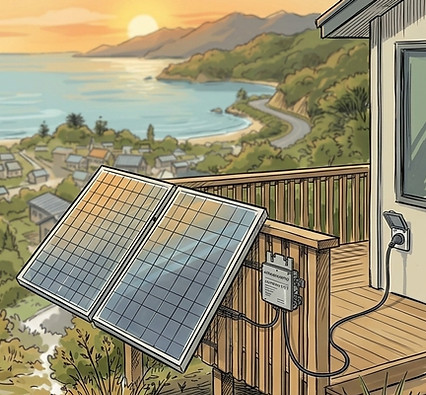
Three parts. That is it.
Traditional rooftop solar is a building project. Plug-in solar you can setup yourself. Its literally plug and play.
PART 1
One to four solar panels
Standard panels, the same kind you see on rooftops. They turn sunlight into direct current (DC) electricity. Mount them on a roof, a deck, a balcony rail, a fence or the lawn.
PART 2
A microinverter
The brains of the system. A small box that converts the panels' DC into the same 230 volt alternating current (AC) your house already runs on.
PART 3
A normal power point
The microinverter's cable plugs into an ordinary NZ wall socket, ideally an outdoor one.That is the connection to your home. Nothing gets wired into the switchboard.
Follow the power
Electricity always takes the shortest path. Solar power from the powerpoint goes straight to whatever is switched on in your home before a single unit comes from your power retailer.

1. Sunlight
Hits the panels, even on cloudy days, just less of it

2. Solar panels makes DC
Direct current, the kind batteries use

3.Microinverter makes AC
Household 230 volt power, synced to the grid

4. Your home uses it first
Fridge, router, washing machine, heat pump
Need more than the sun is making?
The grid tops up the difference automatically. You never switch anything over. Your lights do not flicker. Your meter simply spins slower.
Making more than you are using?
The spare flows out to the grid for your neighbours to use. Be clear on this: plug-in solar earns nothing for that surplus. Your savings come only from the power you use yourself.
Why daytime habits matter
Because spare solar is gifted to the grid, the trick is to use as much as you can while the sun is up. That is called self-consumption, and it is the whole savings story.
Every unit you make and use yourself is one you do not buy at around 39 cents (national average, MBIE, February 2026).
-
Run the dishwasher and washing machine on a delay timer for midday
-
Heat your hot water cylinder in the middle of the day
-
Charge the e-bike, laptop and tools while the sun is up
-
Fridges, freezers and routers run all day anyway, so they soak up solar for free
WHAT A SYSTEM GENERATES
About 1000 kWh
a year in Auckland, and up to 1,200 kWh a year in sunny Nelson
Generation is not savings. What you save depends on how much of that you use yourself, and a battery changes that a lot. See the battery option.
OPTIONAL EXTRA
Add a plug-in battery and keep your sunshine for the evening
Most Kiwi households use the most power when the sun has gone: dinner, lights, TV, heat pump. Without a battery, a lot of your midday solar flows out to the grid while you are at work. A small battery catches that surplus and gives it back after dark.
PANELS ONLY SYSTEM
40 to 60%
of the solar power you make gets used in your home, depending on your household habits and system size. The rest is gifted to the grid.
-
Lowest upfront cost
-
Best if someone is home during the day
-
Add a battery later if you want
PANELS & BATTERY SYSTEM
Up to about 80%
of the solar power you make gets used in your home, because the battery saves the midday surplus for later.
-
Puts most of your solar to work in your own home
-
Best if the house is empty during the day
-
Extra upfront cost
How a day looks with a battery
Midday
Panels power whatever is running. Anything spare charges the battery instead of flowing out to the grid.
Evening
The sun drops and the battery takes over, powering dinner, lights and the TV with the solar you made earlier.
Overnight
Once the battery is empty, the grid tops you up as normal. Next morning, the cycle starts again.
Power cut? Keep your essentials running
Panels on their own switch off when the grid goes down, so lines workers stay safe. A battery with an emergency power socket keeps going. Plug your fridge, wifi, phone chargers and a lamp straight into it, a 6 kWh battery will run them for about three days.
It powers what you plug into it, not your house wiring, hot water, oven or heat pump.
Is plug-in solar safe? Here is what the microinverter does
Fair question for anything that plugs into the wall. The safety is built into the microinverter, which is required to meet the same anti-islanding standard as rooftop solar inverters in New Zealand.
Unplug it and the pins go dead
The microinverter only produces power when it can sense the grid. Pull the plug and it shuts off instantly, so the pins are not live.
Power cut? It switches off
If the grid goes down, the system stops, so no power flows back onto lines workers are fixing. Panels alone are not a backup supply. For that you need a battery with an emergency socket.
Your home's protection still works
The system sits behind your existing circuit breakers and RCD, the same safety devices that protect everything else you plug in.
Proven at scale in Europe
A few million plug-in systems are installed in Germany, the UK and other states with no safety incidents reported from panels-only systems.
THE HONEST BIT